How does the “decompression curve” of a memory foam pillow material create on the spine?

If you lie down and gently place your head on a high-quality memory foam pillow, you might feel its softness and conformity, as if it were custom-made for your head and neck. In fact, this comfort is backed by a scientific mechanism—the material of memory foam can form a “pressure-relief curve,” helping your spine maintain its natural alignment and reducing pressure on your neck and shoulders.
Many people mistakenly believe that a pillow is simply “soft,” but in reality, support, curve conformation, and pressure distribution are the key factors that truly determine sleep quality.
Why do ordinary pillows fail to create a pressure-reducing curve?
Before discussing memory foam pillows, let’s look at the limitations of traditional pillows:
- force andUneven support: Ordinary cotton pillows, down pillows, or fiber pillows often collapse too quickly when subjected to force, and cannot support the head and neck at the same time, making it easy for the spinal curve to deviate from its natural state.
- -pressureConcentrated pressure: When the head is pressed down, the high pressure point often appears at the bottom of the cervical spine or at the junction of the neck and shoulders, causing local discomfort or morning soreness.
- Significant deformation: Traditional pillows tend to collapse when you turn over or change your position at night, resulting in unbalanced support and potentially uneven pressure on the spine during sleep.
Therefore, ordinary pillows often fail to create a continuous and stable “pressure relief curve” during sleep. The advantage of a memory foam pillow lies in its ability to intelligently conform to the shape of your head and neck, maintain natural spinal alignment, and distribute pressure.
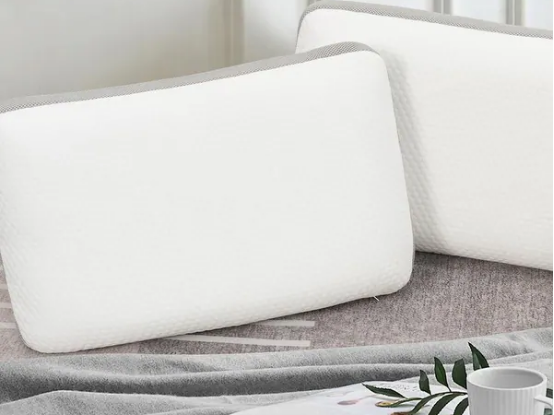
Material properties of memory foam pillows
The physical and chemical properties of memory foam make it the core of the decompression curve.
Viscoelasticity: Slow rebound creates a snug fit.
- immediately butWhen your head and neck press down on the memory foam, it won’t collapse or bounce off immediately, but will slowly conform to your shape.
- As the pressure gradually dissipates, the head, neck, and shoulders naturally “sink” into the support area.
- When you change your sleeping position, the memory foam dynamically reshapes itself to maintain spinal alignment.
- This viscoelasticity makes the pillow both soft and supportive, which is unmatched by ordinary pillows.
Temperature and pressure response
- Memory foam is heat-sensitive: body temperature softens the foam, allowing it to better conform to the curves of the head and neck.
- Even pressure distribution: It prevents any area from being subjected to excessive pressure, thereby reducing pressure on the shoulders and neck.
In other words, memory foam is a “smart material” that can automatically adjust according to your body shape and temperature, ensuring both comfort and support.
How pillow structure and materials work together to create a pressure relief curve
Besides the materials, the shape design of the pillow is also crucial:
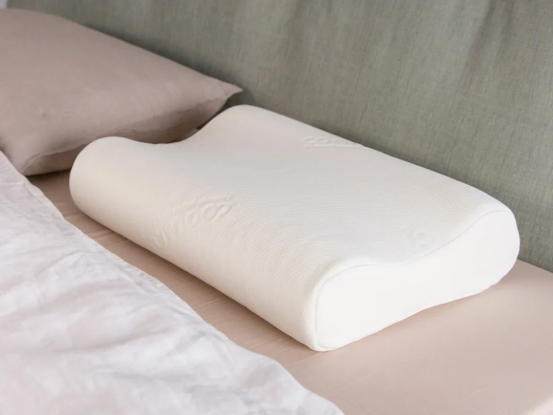
Ergonomic contour design
- Most memory foam pillows have a concave center and slightly higher sides, forming a natural curve that conforms to the head and neck.
- When lying flat, the head is in the concave area, the neck is supported by both sides, and the shoulders are in stable contact with the bed surface.
- When sleeping on your side, your neck can still be supported, and your spine can remain in a natural straight line.
Suitable density and support
- If the density is too low, the support will be insufficient and it will easily collapse; if the density is too high, it may be too hard.
- -densityMedium- to high density memory foam strikes a balance between softness and support, resulting in a more stable decompression curve.
Dynamic Adaptability
- When you turn over or change position during sleep, the memory foam pillow will reshape itself to maintain support and fit.
- Compared to traditional pillows, it can more effectively distribute pressure, reduce muscle tension, and reduce uneven stress on the spine.
Scientific research support
Multiple studies have shown that memory foam pillows have significant effects on spinal decompression and support:
- Improved spinal posture: Studies show that using a memory foam pillow can maintain the natural curvature of the cervical spine when sleeping on your side or back.
- Reduces neck and shoulder discomfort: Long-term users report a significant reduction in morning neck and shoulder pain and a decrease in the number of times they turn over at night.
- Pressure dispersion effect: Compared with traditional pillows, memory foam pillows can evenly distribute the weight of the head and neck, reducing local pressure peaks.
concept butIn summary, the “pressure relief curve” of memory foam pillows is not a theoretical concept, but a practical benefit verified through research and practice.
How to leverage the stress-relief benefits of a memory foam pillow
To ensure your memory foam pillow is truly effective, try the following methods:
- Choose the right height and density: People who sleep on their back, side, or in a combination of positions should choose a pillow with the appropriate profile and density.
- Maintain the correct sleeping posture: head in the central concave area, neck in the support area, and shoulders naturally resting on the bed or the edge of the pillow.
- Avoid pillows that are too soft or too flat: pillows that are too soft are prone to collapsing, while pillows that are too hard will cause discomfort.
- Regularly check and replace your pillow: After 2–4 years of use, the memory foam may lose its elasticity, and its support will decrease.
Life tips for using memory foam
- Pillowcase selection: Cotton, breathable, and warm pillowcases are the most suitable to keep the head and neck at a moderate temperature and improve the fit.
- Pillow care: Gently pat or shake the pillow every week to redistribute the internal air bubbles and maintain its softness and support.
- Rotate the pillow every few weeks to avoid excessive pressure on one side and extend its lifespan.
Why choose a memory foam pillow?
- It conforms to the curve of the head and neck, reducing pressure on the shoulders and neck.
- Its slow rebound characteristic provides stable support and forms a reliable decompression curve.
- Temperature response and dynamic shaping ensure that the spine remains naturally aligned even when sleeping positions change.
- Choosing a suitable memory foam pillow can not only improve sleep comfort but also help protect cervical spine health in the long term.

Summarize
- The decompression curve of memory foam is due to the combined effect of viscoelastic materials, contour design, and dynamic adaptability.
- It conforms to the curve of the head and neck, distributes pressure, and keeps the spine in natural alignment, significantly reducing neck and shoulder pressure.
- By choosing the right height and density, maintaining the correct sleeping posture, and providing proper care, the advantages of memory foam can be fully realized.
- For those looking to improve their neck and shoulder health, choosing a high-quality memory foam pillow is a wise investment in sleep and wellness.
Through these methods, your memory foam pillow can not only make you sleep comfortably but also truly create a spinal decompression curve, promote cervical spine health, and improve sleep quality.