From NASA to the bedroom: How memory foam pillows remember your sleeping position

We sleep every day, but many of us don’t actually rest.
Some wake up with stiff necks and sore shoulders; others toss and turn all night, unable to find a comfortable position. So we start to wonder: Is it the bed? Is it the wrong posture? But the answer is often simple: it’s the pillow. It doesn’t understand your body.
There’s a pillow designed from birth to understand you.
It originated from NASA space technology, yet it’s found its way gently into everyone’s bedroom.
It’s called a memory foam pillow.
From space capsules to bedrooms: The story of memory foam
You might not know that memory foam wasn’t originally created for sleeping but to protect astronauts.
In the 1960s, NASA researchers, while exploring how to cushion the enormous pressure astronauts endure during takeoff and landing, invented this foam material that automatically deforms according to changes in human body pressure.
This material has a special property—slow rebound .
That is, when you press on it, it will slowly sink along your shape, and when you leave, it will slowly return to its original position, as if it is “remembering” the shape of your body.
Later, the technology was brought back to Earth and entered into areas of life such as mattresses, pillows, and chairs.
In other words, the “memory foam pillow” you sleep on now actually has a bit of space ancestry.
Does it really “remember” you? Scientifically speaking, it “senses” you.
The word “memory” is actually a gentle misunderstanding.
It is not really a memory, but a physical property based on temperature and pressure response .
When you sleep on your side, back, or stomach, the pressure distribution on your head and cervical spine will be different.
Ordinary pillows cannot recognize this difference, but memory foam can “understand” it.
Temperature Response: The foam becomes softer when it encounters body temperature, conforming to the lines of your head and neck.
Pressure Sensitive: It sinks more where there is heavy pressure and maintains support where there is light pressure.
Slow rebound feature: When you turn over or adjust your posture, it will not “rebound immediately”,
but will maintain for a certain period of time to prevent your head and neck from being “woken up”.
So, memory foam pillows are not “remembering” you but dynamically adapting to you .
Every night, it relearns your sleeping position—this is its gentle wisdom.
Why we can’t live without “curve design” and “wavy pillow surface”
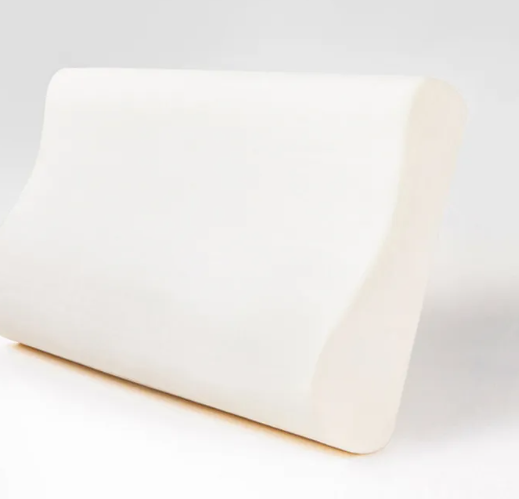
After the emergence of memory foam Pillow, it was its design that truly changed the experience, especially the wavy/curved pillows , which are almost the hallmark of modern ergonomic pillows .
You may notice that it is low in the middle and high on both sides, shaped like a soft “wave.”
This design actually imitates the natural curve of the cervical spine:
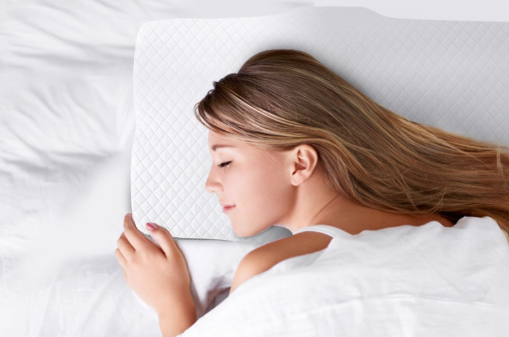
When sleeping on your back , your neck is supported, your head sinks, and your spine forms a relaxed “C” shape.
When sleeping on your side , the higher side can support the space between your shoulders and neck to prevent compression;
When turning over , the slow rebound allows the head to move smoothly without “bouncing” and disturbing sleep.
In other words , it’s not about you obeying the pillow, but about the pillow obeying you.
This is the essence of “curved support”: understanding how people rest from the perspective of shape.
The pillow lies precise support
When many people touch a memory foam pillow for the first time, they will say, “So soft, so comfortable!”
But what is really amazing is not the softness, but the perfect support.
Traditional pillows tend to “collapse” or “bounce back too quickly,” but memory foam Pillow provides delicate, layered support through its slow rebound properties .
When you press on it, it doesn’t sink to the bottom all at once, but sinks slowly;
It will support you where the pressure is greatest, distributing the weight evenly;
When you turn over, it doesn’t push back, but gently “holds” you.
This subtle difference in rebound is why many people say after using it for a few days, “It feels like I’ve finally slept in a place where I’m understood.”
It is a sense of security – the body is gently wrapped, and gravity is caught. This is also the real magic of memory foam’s “soft yet stable”.
Temperature beyond design: Why does it make people relax?
Sleep isn’t just about resting your body; it’s also a ritual that restores your emotions .
When you lie down, your body needs more than just rest; it also needs a sense of security and acceptance . Studies have found that a soft, slow, and conforming touch can increase the secretion of “calming hormones,” lowering heart rate and anxiety. Memory foam leverages the psychology of touch to create a feeling like being held .
The feeling of being slowly wrapped is actually the body telling the brain, “You can sleep peacefully now.” Therefore, you are not healed by technology, but soothed by the “softness of understanding.”
Are memory foam pillows comfortable?
Many people feel that the memory foam is “a bit hard” when they use it for the first time. In fact, that is because the memory foam needs body temperature to “activate” its softness.
When you first touch it, it is still in a cool state;
After a few minutes, when the foam senses the temperature, it will fit the curve of your neck.
From the experience point of view, its “comfort” is not in the first second, but in the second half of the night;
If an ordinary pillow would have been deformed and collapsed, only the memory foam would still be silently supporting you.
In particular, the memory foam pillow curve design slow rebound wave shape can accurately support the neck and shoulder lines and relieve morning stiffness and soreness.
If you’re looking for that feeling of “being quietly supported”—yes”, memory foam pillows are really comfortable.
But the premise is: you are willing to give it a few nights to let it get to know you.
Summary: You are not choosing a pillow, but choosing a way to rest
From NASA’s experimental cabin to the night light next to your pillow, memory foam has spanned half a century to solve only one problem: to make your body understood, not just made up.
What it “remembers” isn’t the shape, but the way you fall asleep, the rhythm of your breathing, and the weight of your fatigue.
When technology learns to be gentle, when the pillow learns to listen, we can truly learn to rest.
If you’re searching for a pillow that’s “just right” every night—no sinking, no rebounding, and no neck tightness—perhaps you should try a memory foam pillow curve design slow rebound wave shape .
Let it take on all your pressure, and starting tonight, learn to truly sleep and be understood.